Completed the ‘The Compassionate and Inclusive Leadership’ programme
Managing Conversations
Managing Conversations is a 2 hour session delivered virtually and face to face in Weston and Bristol. The course focuses on what difficult conversations are and how you can undertake these conversations with confidence in the workplace. click the link above to sign up for the next available date on Kallidus.
Motivating Teams
Motivating teams is a 2 hour session delivered virtually and face to face in Weston and Bristol. The course focuses on what motivates you and your team and how you can motivate yourself and your team. click the link above to sign up for the next available date on Kallidus.
Coaching to Lead
equip managers with knowledge and skills to support and develop their staff through coaching.
To define the principles and benefits of coaching
to practice the key skills of questions and listening
to have an understanding on how to apply coaching behaviours in everyday team leadership / management through the TGROW model
For line managers (and others who assume line management responsibility).
Supporting Performance
To equip managers with knowledge, skills and tools to support their staff to perform their roles.
Explore a compassionate and inclusive approach to supporting performance
Introduce the performance cycle and discuss ways of applying this
share methods and tools for Goal setting, giving feedback,
Diagnosing and addressing performance problems
For line managers (and others who assume line management responsibility).
Digital Learning Institute – Professional Certificate in Accessibility and Universal Design
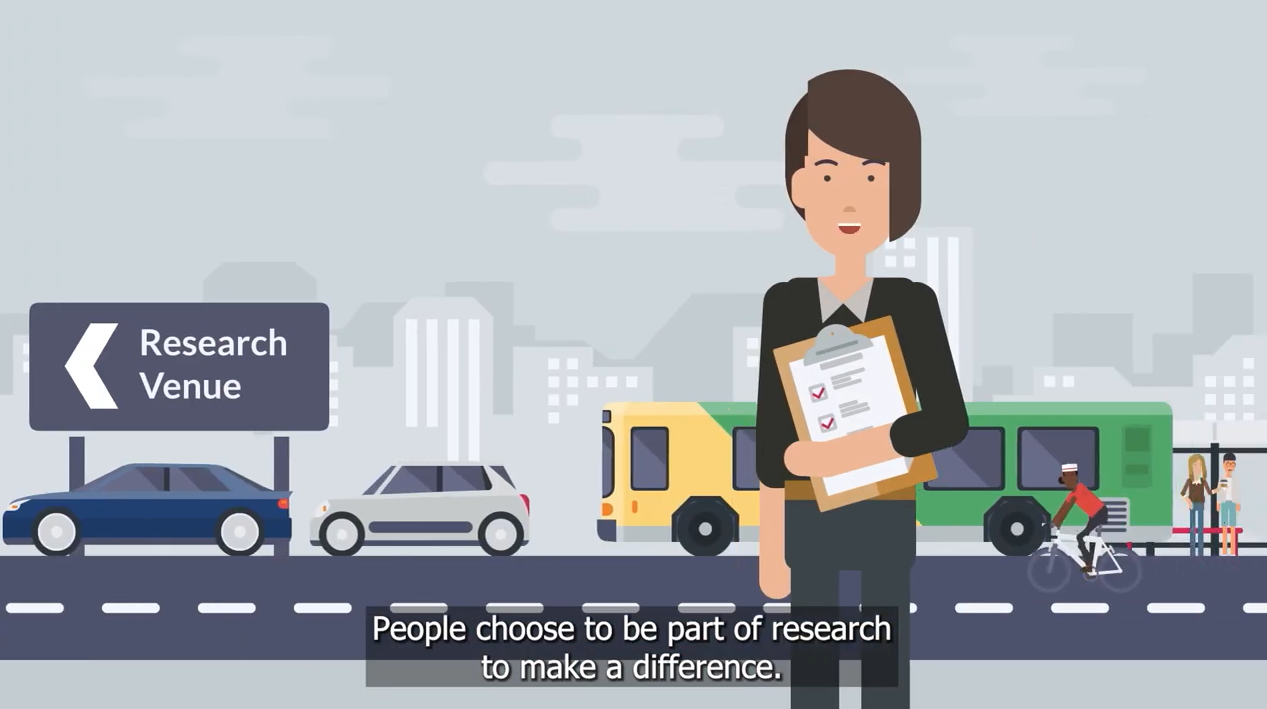
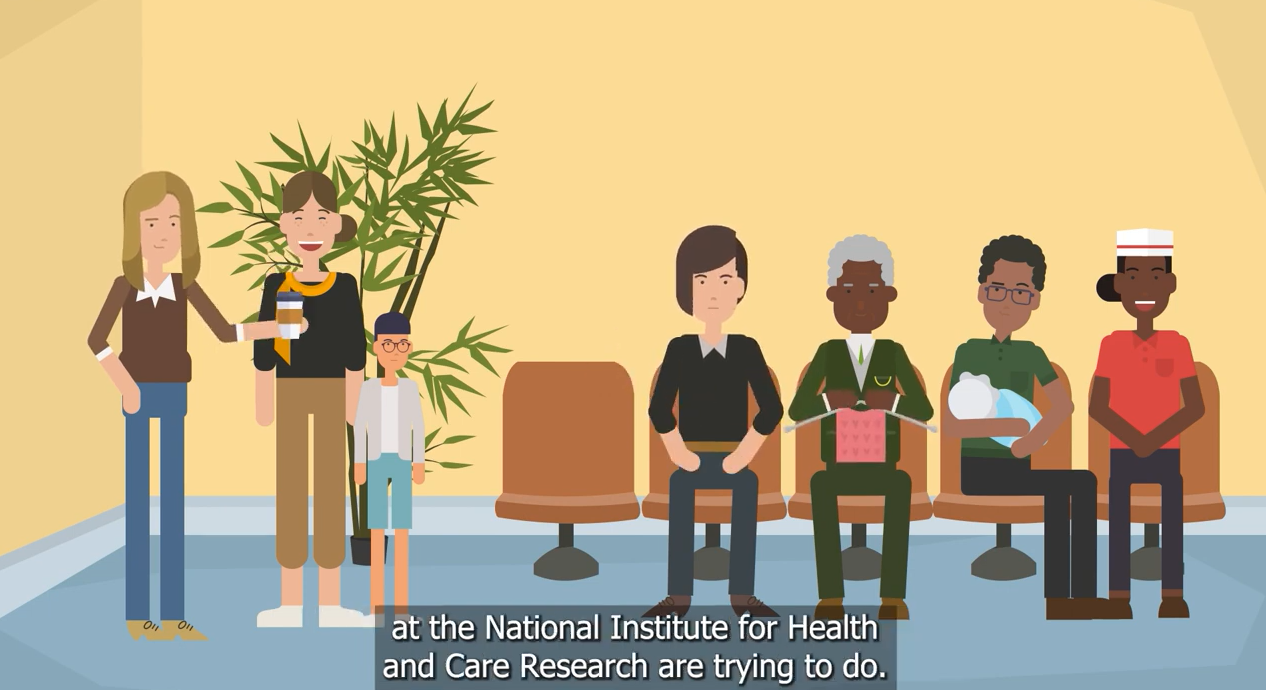
I created this with local stakeholders in Wessex. This short animation is now deployed in clinical settings and on websites and introduces to clinical staff the importance of the NIHR PRES survey.
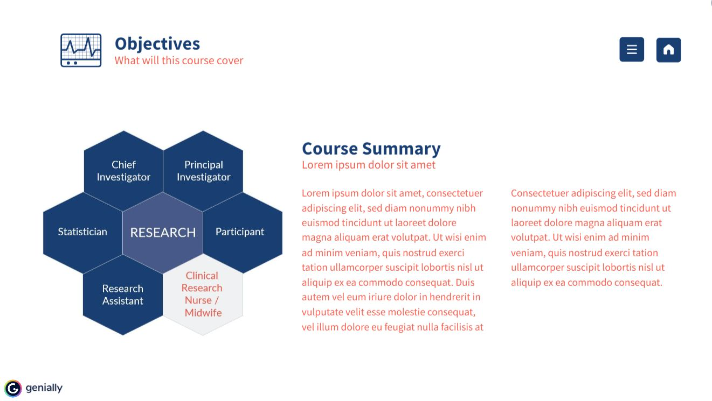
Genially has been ranked as the 46th best learning tool in 2022 by the Top Tools for Learning list. As someone who has tried it, the free trial at least, I can say it is easy to use and can create multiple types of content. Including e-learning screens / slideset learning experiences.
What did I think? What a 180 I did on this product! At first, I didn’t like it. I pigeon holed it as H5P+ with a few questionable design choices. I really get turned off by cartoony / interesting looking design choices. I am Mr Brutalist after all.
Over time, I started to see past some of the template designs and came to appreciate the flexibility it offered. I was genuinely impressed in what was under the hood in terms of variety and the amount of use cases it would meet. One thing I appreciated was the good accessibility support, but I did find the chatbot’s response on exact accessibility issues to be a bit vague.
Genially is in the same space, for me, as Easygenerator, Articulate, Synthesia and Adapt. I would certainly look at them if I was a small firm / learning and development team looking for less corporate / generic authoring straight out of the box. Ultimately, the winner will be determined by the price point and the business model attached to their offers.
A few quick tips for making Articulate Rise look nicer.
1. Turn off block animations. They are a little naff and not the best for accessibility.
2. You can add emoji’s. Use the shortcut ‘windows key + .’ for the menu. Use sparingly. Emoji’s are standard issue to us older millennials but to younger generations they are naff and hard to understand. See the example below for a good use of how to deploy them so they enhance understanding.
3. You can add some flair to text by topping and tailing with a background colour image that gives something other than straight lines. You can make these easily enough on Google Slides and output .SVGs.
One of the unintended things from the sudden explosion of AI is the associated moral panic. NOT the skynet world-endy stuff but a more corrosive and slow burn consequence.
If we come across some prose we don’t like or a slightly formal presentation style we can get annoyed. Annoyed because we assume someone has taken a shortcut and used AI and the product is therefore less meaningful. I have seen people say online ‘Did AI write this twaddle’ as an insult. That is the accent of AI is little plastic and lifeless at the moment. I have also had some experience of super professional quality stuff being feedback on negatively as people assumed it was AI… and therefore couldn’t connect with it.
Now this rings bells for me. I have felt this before. It feels a little like the culture wars between guitar music and electronic music. I once offered to DJ for free at a super cool venue in Bristol and they politely declined my offer. They stated that they have ‘real” music there sometimes. Apparently wedding bands being better than anything electronic. That somehow the technology intervened to the point where they couldn’t connect on a human level. Despite at the root of it it still being humans playing for humans.
I am sure we will have debates about AI created art and also trust on social media. I don’t welcome these as they are hard and also very boring. Yet already there is a fault line or a new weapon in the arsenal of people trying to critique something they don’t like. I think it is worth noting as a side skirmish on our way to the bigger wars ahead.
Thought for the day: By the time you get to 30+ years on earth you will become very familiar with Maslow’s hierarchy of needs. You may even be able to critique it quite pithily at dinner parties or use it to discuss zombie movies. However, it is seldom helpful in your working life. Unless you are a policy maker, social / health worker or leader you kinda don’t have to factor into your work whether someone has shelter or not.
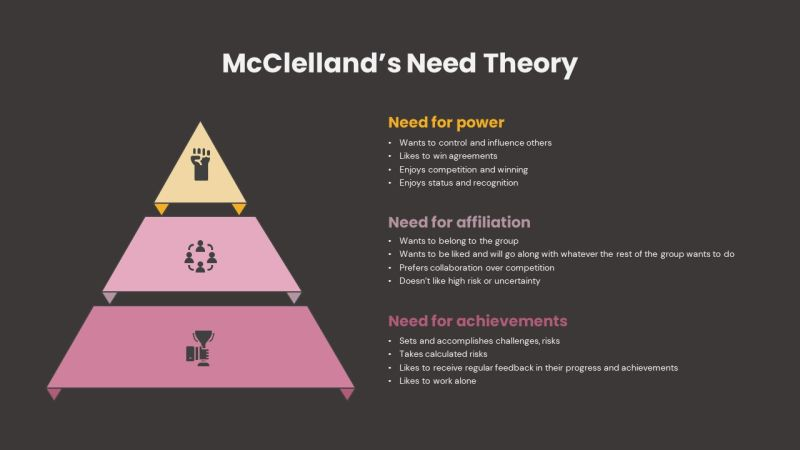
During a training session yesterday I was introduced to McClelland’s needs theory. I may have seen it before but I didn’t recognise it. A similar triangle based presentation of work place motivation. Looking at google it has been rearranged multiple times to be part of Venn diagrams, line graphs or just flattened into bullet points. I can’t find much criticism about it beyond some ‘where’s the science bro’ type sentiments.
It got me thinking about the order or things and motivation. In the triangle shaped hierarchy the bottom layer is ‘Achievement’. It underpins the other motivations such as affiliation and then finally the motivation to exert ‘power’. I think most British people have disdain for the power tier and would find it antithetical to ‘Affiliation’. I think it sits best as a hierarchy.
It was just the frame I needed for my current thinking around work and careers. For me I think the motivation to achieve things during my working day is super strong. Without it being satisfied the other motivations have shaky foundations and are liable to crumble and fall away. If I am not achieving success during my work I have little to no interest in affiliation or exerting power. This theorisation of how I relate to work, whilst not revolutionary, is very useful as I go forward in my career.
Quote from an e-learning tool vendor sales email. “In terms of accessibility, AUTHORING TOOL itself is not accessible, nor are there any efforts planned to make it accessible”. I just don’t know if any other kind of discrimination would be so blithely embraced by a company but here we are.
Calendar Gore. The messy impenetrable morass of colours, placeholders and reminders that make people’s availability incredibly hard to understand.
Take down these COVID signs if they aren’t accurate – March 203
You wouldn’t put on your website ‘Must eat cereal whilst in the premises’ if you in fact had no policy on cereal on the premises.
Bonjour! Aujourd’hui I would like to talk about the digital and built environment inspired by my recent trip to Brussels. We were wandering through the various websites, apps and checkpoints needed to visit the parliament of the European Union and something stood out….
In the built environment there were no requests or facilities for wearing a mask. You were welcome to but there was no compulsion. On the booking app and the website it was still stated as very much a mandated course of action. We seemingly accept our apps and the websites giving incorrect information.
This tallies with my general experience of pandemic easements. During the height of the national concern over the coronavirus we invested so much time in our end users experience of digital. Whether they were students, learners or visitors. We needed to ensure the information we gave them matched the fast changing nature of our social terms of engagement.
Whether it is down to people not wanting to think about the pandemic, not wanting to be seen to move on from it or just having been burnt one too many times by it we still accept a lot of incorrect messaging. It is not exclusive to digital, we can see plenty o’signage in public spaces that are wrong, but I get a feeling that the digital is back to being the second order mode. Where we let messages, images and policies wither and die because it is not real. Our energy and attention for it has been well and truely spent.
The bottom line is this. Don’t tell people something is mandatory if it isn’t even recommended. It is simple. So to do this, invest some time in doing a post-pandemic or mid-pandemic (delete to your preference) cleansing on your digital estate.
Sort your target operating model out – January 2023
📢 📢 I’m back on my hobby horse 📢📢 Please excuse me completely ignoring AI. I find it a heady mix of being incredibly dry and also really scary. So let’s talk about something else. Something older and more pressing but frame it as a conversation about AI.
☢ ☢ Digital Learning and Learning Technologists are at RISK from no longer existing. SKYNET is here and it’s talking out jobs!! ☢ ☢ Or something.
Institutions have been dragged through a pandemic through many processes of Digital Transformation and yet you can see that institutional attention span wandering. So let me say it loudly:
🎺🎺 Learning Technologists and Digital Learning Professionals have earned the respect to be treated as part of the conversation. 🎺🎺
They should be part of the digital transformation mix. We should be past the days of disparate jobs titles within the same organisation. We should be passed the point of cottage industries where some people do the same work and have a different job title and radically different pay. No career ladder. No way of switching between designer and developer or manage roles. This should be the past.
Solving this isn’t something for tomorrow it’s for yesterday. If your organisation still has this, they are failing. If your HR department has allowed this, they are failing. If you are a senior manager this is your job to sort. If you haven’t or aren’t invested in solving it, you are failing.
It’s time to start asking these difficult questions and expecting answers because soon the tide of rubbish AI products is going to swamp the sector. These products will soon make a home in any weaknesses in your structure and they will grow and they will be worse.
You cannot protect a way of doing things if you have no target operating model. If have no theory of change. If you allow a frankly BS approach to digital transformation based on luck and occasional drive. Because I promise you this, those professionals who went the extra mile to support you even when it made them uncomfortable, you will miss them when they are gone.
In my current role I have been bequeathed a lot of defined and codified learning design processes. I don’t necessarily get to use some of it that often as a lot of it is to do with new work and we, like a lot of people, are still continuously improving the huge efforts made during the pandemic pivot. So this means reviewing a lot stuff and focusing on those tools and processes.
It’s more paperwork than I am used to for two reasons:
Firstly, coming from an HE environment previously that never quite allowed us to get to codified learning design processes I have always adopted quite freeform or teacher lead processes. What I would have given for the crutch of a carpe diem, ABC or even ADDIE process. Yet at times this was even expressly discouraged.
Secondly, digital learning roles can sometimes collapse loads of different roles into one. From project manager/lead through to designer or developer. For this role the project management strength prior to my arrival meant we have a lusciously plotted out process and supporting paperwork.
Yet my reflections are similar for both the processes attached to new developments and the review processes. As amazing as it is to have a process and documentation they are not neutral tools. Documents and processes are made by humans and focus on lots of institutional priorities above and beyond project success or interesting pedagogy. It isn’t until you try and use these tools that you notice what ‘is’ and ‘isn’t’ supported / encouraged by the bureaucracy.
Mercifully in my two processes for reviewing and creating e-Learning there are gaps. For example, the new project development is relatively neutral / none-prescriptive on how to design or support design of a learning experience. There are tools to support design elements but compared to the paperwork in ABC the paperwork supports the process of getting a product to market not really what that product is pedagogically. Which is actually really handy for a knowledgeable designer to go on a case by case basis.
Similarly for our review paperwork. This paperwork sets out the process of the review. Not what needs to be reviewed and for what. Which in this instance allows flex for different types of learning experience. Again a good bit of flex. Yet it also has the dis-benefit of not disciplining newer standards onto older resources. This is the kind of thing you want to be prescriptive for legislation and tools change as do individual learning object risk profiles.
Anyway the story I wanted to outline above is this… paperwork isn’t neutral. Not much of it is evidence based because why would you develop that evidence base. Some flex and area for interpretation is great and some is problematic. So as much as you monitor outcomes of processes don’t forget to review and continuously improve to process and tools themselves.
Tom Buckley is Digital Learning Manager in the Education Innovation Team. The local learning technology support team in the Faculty of HAS. He has worked in educational development and technology for over 10 years. Tom manages the recruitment for the team and this is his perspective on becoming a Learning Technologist at UWE. The quotes provided here are from employees within UWE taken during focus groups in 2020.
Who is this article for?
This article is for those who are curious about a new career and interested in finding out more about the role of ‘Learning Technologist’. ‘Learning Technologist’ is a new cadre of professional primarily within educational institutions. It is a role that provides a particular service but a service that can differ wildly. People can often be aware of Learning Technologists within an organisation but have no idea where they come from. The good news is that people are not born as Learning Technologists they become them. The bad news is they become them without having a particular training course or route into the role. Meaning it can be unclear how to get started with a career as a Learning Technologist and also what the job entails. The article and shared testimony aim to address this.
What is it aiming to do?
The 2020s COVID 19 pandemic drastically altered the education sector’s approach to using technology in teaching. It has been one of the few instances where Learning Technologists have been pivotal to a crisis response. It has shone a spotlight on their importance and is a growing part of the jobs market. There are plenty of opportunities for long and rewarding careers in learning technology. This article is aimed at helping you assess whether you’re the right candidate and, if you are, making sure you know how to make yourself competitive in the application process.
About the role
What is a Learning Technologist?
The complexity in explaining the role comes from how specific it is to the Higher and Further Education sector. This is compounded by the variation with what the role does between, and even within, institutions. This can ultimately be as drastic a differenced as whether the role is seen as more academic, technical, administrative or more generalist. This variability also manifests itself by where the role is situated. Whether it is situated in: a local Faculty team; a central team; or a pan-institutional service like a library or IT service. Some Technologist roles are tool focussed whereas others are pedagogy focused. It really comes down to the particular role you are looking at. Whatever the role there are pervasive and universal parts to any Learning Technologist job. That is being active in the digital transformation of education.
You will: advise; coach; research; & support teaching and learning. You are in the business of change, partnership and improvement. The focus is always on improving student’s experience or learning. Notice how I have not mention digital in that list. This might surprise you. It is obviously important to the role but not as important as supporting positive change. Sometimes this change will be knowing when not to digitise things.
Why did existing Learning Technologists apply for their roles?
As mentioned there is no academy or course to become a Learning Technologist. The thing that may surprise you is a lot of practitioners didn’t know what one was before applying for their first role. The rationale for applying differs between practitioners:
“… I don’t think the job of ‘learning technologist’ had been at all on my radar until I saw that job advert and I read it and it sounded like it really matched my skills.”
“I just thought that it was really cool…”
“It’s genuinely not something that I had known much about coming into it…everything I’ve done has kind of led up to this point”
You might recognise the thoughts above and that might be why you’re reading this article. That is good. Learning Technologists, amongst the other traits, are curious by nature. So don’t be put off from applying just because the job title sounds exclusive or niche. We all have come from different walks of life to become a Learning Technologist.
What does a Learning Technologist do all day?
This is a tough question. Learning technologists job roles change daily and depend on the time of year. Here are what our practitioners have to say:
“The beauty of the role is, no two days are exactly the same…before the start of the academic year; one is working on getting courses ready for the next year. Once the academic year starts… training, support (pedagogical and technical), problem solving, research…and sector trends, plus lots of meetings.”
“the day is quite varied…it does sort of depend on what projects are happening or what is generally just happening in the day… what I do is just about helping people. So whether it’s giving people advice or just doing little training sessions… or creating things with people… It never feels boring or repetitive because you’re doing quite a lot of different things.”
Our focus group touched on the ontology of the job or simply ‘the vibe’ of the job. This is an important part of understanding the role and changes unit to unit or between organisations. However, there is a distinctive feel working within digital education.
“you can be quite individual and innovative …it’s essentially helping people. Understanding what the problem is… working out how they can solve it and understanding where they’re coming from. Also providing written guidance…communication in all sorts of different forms, but I think that’s the main difference against a Technical role is that it’s not just about, you know, understanding a piece of software …”
“There is a lot of agency and with that a small amount of pressure that comes from being accountable for the time you have chosen to spend on stuff.”
A lot of what is required in the role comes from the type of person within that role. You have to be inclined to help people but also have the drive get stuck in on digital projects. You need to be a problem solver and a horizon scanner but fundamentally someone dedicated to the student and staff experience. What you do will vary but it will always be framed as helping people and supporting change. So the question you need to ask yourself before applying is how much drive you have to shape your role and help others. How much you are interested in ‘a job’ or whether you want to become a practitioner of something. If you crave structure, boundaries and consistency this might not be the role for you.
About you
What kind of person is a Learning Technologist?
Individuals drafted into learning technology alongside practitioners to help scale up operations during the pivot to online learning caused by the 2020s COVID 19 pandemic shared these thoughts on working within digital education:
“The community is… Resilient, helpful (to each other as much as to academic staff), approachable. Supportive, Knowledgeable, Curious.”
“A learning technologist is… dedicated, lateral thinking and self-motivated. Passionate, hard-working, thoughtful and kind.”
These stakeholders had the ability to relate the job to a more technical role. Learning Technologist is sometimes read as a synonym for IT which is unfair for both disciplines.
“The main difference is… The range of demands whether it be the vast array of software and platforms or the wide range of academic confidence. Dealing with solving problems and developing practice”
Learning Technologists can be part of a service but they seldom work in a service model of delivery. They are more involved in partnership working. So you focus on people, projects, pedagogy or outputs rather than working to a standard of universal service. This is where the difference can be felt between being a learning technologist and being another type of professional. You need to follow things down rabbit holes and smash through dead ends. An agent for change rather than a provider of a service. The word ‘No’ can be in your vocabulary but you are more likely to say ‘actually I would suggest doing it like this’. Usually alongside ‘shall we have a chat about it over a cup of tea’.
Who would be a bad fit for or would struggle as a Learning Technologist?
Our focus group had this to say:
“a limited scope of what is possible…a lack of interest in evolving … a poor team player and equally, who isn’t able to work independently.”
“a bad fit would be someone who is not flexible, not creative, impatient.”
“cannot build productive working relationships and communicate effectively”
“structure, stability and predictability. It is impossible to plan a career in learning technology, and the job in itself is a constantly evolving mix of priorities and pressures. It is … for those who are comfortable dealing with chaos on a regular basis.”
Learning Technologists are technologically agile, literate in learning new bits of kit and applying to real world problems. Yet, we are looking for is someone who is kind, patient, flexible with good people skills, who can build a rapport and want to continually grow. These are the core values and the core parts of being a learning technologist.
The right skills are important. You will need to know enough HTML to unpick a faulty embed code and that is about it. There will be peer support and we can teach a lot of the technical elements in post. ‘Digital agility’ is important but pointless if not matched with the right values. A lot of the technical parts are about knowing products you wouldn’t know if you weren’t in the tertiary education sector. So we do not expect this kind of experience on day 1. Just the right values.
About building an application
If you like the sound of the above then I encourage you to think about applying. It is currently a super competitive jobs market. Here I wanted to give some guidance on building an application that is going to get you noticed.
Firstly, here are my personal top three application red flags:
Primary and secondary level teachers not displaying interest in the field of learning technology within their application. It’s a distinct discipline from teaching. Often applicants give off a ‘I’ve been a teacher so this will be easy’ attitude in the application. It is different. Display you understand that in your application.
IT professionals not displaying interest in the role of being a Learning Technologist in their application. It’s a distinct discipline from IT. Display an understanding of and interest in the interplay between technology and learning in your application.
Not showing signs of research about learning technology/digital education or the specific role of Learning Technologist. It’s a discipline that produces lots of online content. Finding out about the discipline is easy to do. The interview process shouldn’t be seen as a research exercise. So no ‘I would love to find out more about it at interview’ in the personal statement.
It is likely there will be candidates who have postgraduate qualifications in the same interview process. Being up against people with MSc or PhDs in the discipline doesn’t mean you’ll be unsuccessful. Remember it’s about values, behaviours and attitudes as much as hard skills.
Here are my top three tips for applicants outside the sector. By this I mean for people who aren’t already in a related field or a Learning Technologist. The things that will make your application stand out to me are:
Do 2x MOOCs. Each on a different platform. One on a subject you’re truly interested in but outside of technology and learning. The other on e-learning, learning, blended learning or learning development. In the application tell a narrative of your learning, your experience as an online student and how it differed from being a traditional student. The insight this gave you. If you don’t know what a MOOC is then do some research on this subject.
Read the job description of the Learning Technologist role you are interested in and then go to the ALT Blog and the ALT Journal. Scan for words you recognise in the article titles and identify consistent themes or trends. Focus on current or the next big thing that emerges from these articles. Find articles on the core products or approaches from the job description if you can. This will give you literacy in the language used within digital education. This will make you stand out.
Engage with the theories and practicalities of teaching where you are applying for. Firstly, be interested in human behaviour as it pertains to education. For the application show you have done research. This could be research into an aspect of digital teaching or learning theories. Or a reflection on your own educational journey. Most importantly link it to any strategy documents you have found on the recruiters website. Secondly, learn about the core toolset of the institution you are applying for. For UWE this means: Panopto; Collaborate; PebblePad; and Mentimeter. Explore these tools. Mention them in your personal statement. For example you might not know Panopto but you know it is a tool for lecture capture. You can link this to transferable knowledge or experience you have in video.
Good luck!
I hope this has helped add some colour on the opaque role of Learning Technologist. There will be those of you that feel like it isn’t for you. That you might need something that uses more hard skills and has more structure. Good luck finding the right role for you. There are those of you that might have read the above and been further intrigued by the career. I encourage you to contact the named recruiter on the job advert and start the conversation. We need people of all talents to apply so good luck!
Q. What is the aspect of working in Digital Education / Development that would surprise those from another industry?
That it is ‘a game of runs’. This is a phrase used to describe basketball. It means in a game there will be times when the opposition put together a run of baskets. At some point their run will end. Then you will either score 1 basket or put together your run of baskets. Players understand and deal with this.
Whether you win or not is very much down to: how you react to being scored against multiple times in a row; & how many times you can thread your good moments together to make runs that change the game. To do this you need to use your starters and your bench well. Ensure you can put points on the board from multiple parts of your team. Winning is about how you harness your total energies to make a point scored turn into a run of points. That you get enough or large enough runs for a win.
For those in big institutions you may relate to this. You will feel the runs against you. You will feel times where everything is clicking into place. Where you feel like you are getting somewhere. It’s about making sure you have enough in your collective column. To do this, make sure you don’t pin all your hopes on you being the top scorer. Accept the runs against you.
Q. What is the biggest barrier to change in your field?
When I think about a change that achieved something. I think about UoNorthampton. They were trying to move away from lectures & there was a seriousness about it. As an observer you could see an ambition, a hook (new building) & methodology. This plan spanned years. From the outside you could see HOW they were planning to achieve this goal. It had a cool acronym. Basically, they had a theory of change and not just the abstract ‘how’ but the ‘how’ in this specific place and with these specific challenges.
Too often places forget this bit. We concentrate on arguments about the destination & focus on outliers. Things that don’t fit neatly into the stated ambition. We never get to the point where we outline how the transition happens with an explicit process, or staging of events. We expect people to operationalise & arrive at the end point.
Yes, ‘the how’ is hard to articulate. As a sector, much of our organisational structures are based on amelioration & fudge. Too many compromises have been made to allow us transparency without upsetting people. Yet sometimes we get too wrapped up in how cool the end point would be to achieve & leave out ‘the how’. This reticence to state a theory of change openly is our biggest barrier.
Q. What is a ‘good’ leader?
I am torn on whether I know the answer to this. I would have previously said ‘authenticity’ was key. However, I have come to the conclusion that authenticity is problematic. A privilege reserved for those who have security of tenure and more available to people that look and sound like me.
It also only works if your authenticity reveals a good person. If you are more of the real you at work then it should be a positive. Not replacing professionalism with less desirable character traits.
To me a good leader is first and foremost a good person. They have to be inclusive and lead from the front. Husband their resources and nurture the emotions around them. Beyond that it is very contextual. Different styles and traits are relevant for different situations. #leadership
Q. What is the worst pandemic related trend in your sector?
There are a lot of contenders here. Honourable mentions go to: overworking lecturers; putting the prefix #team on groupings of people; proctoring; the gatekeeping of ‘legit’ online learning; & debates about cameras being on or off.
My particular pet peeve is the rise of what I refer to as ‘disaster educationalists’. I don’t mean the literally hundreds of private sector companies who have sent me their undoubtedly brilliant products. Products which will cure all online learning ills no doubt. They are ‘opportunists’, what I dislike is ‘opportunity-ists’.
COVID 19 will bring about many changes. It is the greatest teleological accelerator of my lifetime. It also a once a century omega level threat and tragedy. During this time there have been a handful of people in society (all outside current employer)who rushed to embrace the pandemics ability to bring about change.
I found the tone around it quite distasteful at times. It is not very humane to see the March 20 – March 21 period as anything than a call to care for one another. Make changes for sure but in the spirit of caring and collective endeavour. Not the gleeful space you needed for a prior agenda or chin-stroking opportunity grabbing. #onlinelearning
Q. How does being a ‘millennial’ change how you approach your current role?
I do feel a cohort experience of entering a jobs market does shape you. For me graduating into a financial crisis has certainly given my formative years many scarring experiences. Now I am in a position with some responsibility those experiences frame my practice.
At its most constructive this can be seen in our #recruitment processes. This week we interviewed for a new role. The interviews were on Tuesday. I made sure that the task I gave was inclusive in its form with not too much scope to sink a lot of time into so people wouldn’t over prepare. I want to make the interview meaningful and helpful but not insurmountable and anxiety inducing.
From my own experience the period between interview and the communication of the panels decision can be bad for peoples mental health. I still remember being made to wait months for interview outcomes.
So when I lead these processes I ensure candidates are not made to wait over a weekend. For the process this week I will have given feedforward over coffee to most unsuccessful candidates within the same week with one being done next week. I thoroughly believe it is beholden to all of us ‘to be the person we needed’ at that stage in the applicants journey.
Q. What was the best thing you ever learnt at a conference?
I am very much looking forward to the next face to face ALT-C conference. I attended the last one in Edinburgh and there was a gaggle of us from UWE there. Also some former colleagues which was really good if a little bittersweet.
On the last day there was a short talk and activity on webinars. Principally using the idea of an escape room as an activity for students in webinar break out rooms. After the acute part of the pandemic transition we found some capacity* from the campus based activities having suddenly disappeared. This gave us opportunities to write up some of our own explorations.
This image was from an article written by Hannah Duke in the team. This work was a direct output from engagement with the ALT community at ALT-C. #alt#altc#community#sharing#learning#innovation
* The impact of Flash disappearing went on to take away this capacity but we got some writing up done.
Balancing the ladder
When I manage team dynamics and shape I am very mindful of enabling new entrants to learning technology careers. I always think… would I be able to start a career as a Learning Technologist today and at UWE? Sometimes I think I wouldn’t be able to get an ‘in’ but that because the candidate pool is so talented.
This idea of the ladder in hit home when we revised our structure to remove the use of D grade junior/assistant roles. These roles were an integral part of the pipeline for adding new learning technologists from outside of HE. They were incredibly successful at this. Unfortunately it benefitted the organisations that cherry picked our incredibly well rounded staff. Quite quickly they were in more senior roles at different universities.
To increase our retention the recruitment pipeline now starts at a higher level but I am still desperate to attract people of all talents to careers in digital education. Recently I wrote an article to help applicants from outside the industry get an interview. We need to keep expanding our recruitment pool to people of talent from all walks of life.
If you know people interested in entering a career in TEL then please pass on this article.
In between the conversations of hybrid working, the talk of the future of blended learning, the worries about hybrid teaching & other modern phenomena there is something from the ‘before time’ that haunts me.
I have to admit; I am terrified. Yet for once I am not scared of the pandemic, but of what comes next. I am afraid of the return of ‘the old’ normal.
What is it I dread? The feeling of being stuck. The feeling of inertia. The feeling of listlessness. The feeling of futility. The lack of shared endeavour. Returning to a state where change needed to be unavoidable before being actioned. The acceptance that there are only pyrrhic victories at best.
What is it I dread? Waking up in 2019. Not literally but in working culture and the expectations around innovation. With the only comfort of England being champions of Europe. Let’s hope we return with our eyes fixed forward on 2030 and not back at 2019.
A learning technologist is a job that has many different functions. Two of its main functions are to embrace change and manage risk. To read the road ahead & see where we need to improve. To manage the risks of something going wrong. Embrace and sell that destination but ensure we arrive with as few bumps in the road as possible.
As a cadre of professional you manage a lot of risk on others behalf and you deal with a great deal of uncertainty. After all, no one 100% knows the future. Yet we currently live and work in a perfectly precedented crisis. We know the next few weeks ahead and what they look like. We know where we should be and we know who is stopping us (again) from getting there.
To mitigate it and move to a future state. On this occasion the factors outside of your control mean you cannot actually do that. The country is geared towards not managing the risks of something. Something big. With the stated ambition of returning to a past state. Something knowable but hardly desirable.
A learning technologist instinctively wants to manage risk. This is not unique to this profession but this my perspective. It is quite frankly excruciating to experience again. Remain vigilant & stay safe everyone!
A personal bug bear of mine are the chilling effects that come with working in large organisations. A chilling effect in legal and media terms is the supression of free speech or forms of dissent. I’m talking about this concept as it relates to productivity rather then free speech.
So in a large organisation you will have every single possible outcome or project worked on by some one at some time. ‘X was working on that in 2017’ or ‘Y committee was discussing this’. Some times the knowledge that someone higher up the food chain has discussed something similar means that no other person can discuss that subject. Even if it personally affects them.
It is more bureaucratic than directly oppressive. ‘I don’t want you to waste your time on Z as there is a current project that might mean that is wasted’. More often than not it means nothing gets done with the assumption that someone else will sort it soon. Well here is the rub. They won’t.
If you are affected by something you need to blast through this iron cage, you need to ensure it is dealt with appropriately. If you are the most appropriate way to solve an issue keep rattling the cage. Otherwise it will disappear & you are left with the problem back at the start.
The importance of being kind
Being kind. It is important in work as well as life. All too often we see people struggling and we feel the need to give some feedback. Surely people need to know when they have fallen short and where they can improve?
Working in Higher Education for any length of time often leaves you looking after things that aren’t technically your job. HE is a network of favours and unpaid emotional labours accrued in addition to the day job. All part of being one University with shared goals and ambitions.
However, as so much of our workforce has gone to University we are resplendent with critical thinking. We can critically analyse this, we can proffer an analysis of that or we can deconstruct the other. Very useful in ‘some’ instances but sometimes it gets in the way. Often rather than critique the kind the to do is offer help.
If you see someone in a difficult position, struggling with a responsibility that should be shared then offer to share that load and not just an opinion. This is the kind way of being. This is the collegiate way of being. This is also something you might need reciprocated one day.
Personal news
I have personal news. I am leaving UWE in mid-October. I will be joining the NHS to do Digital Learning stuff there for 12 months, then who knows.
After nearly 10 years there I leave with memories both good & bad but nothing but respect for UWE teaching staff. They change lives.
I would love to return in the future. As I love the place. So won’t be making a big deal about leaving. No ‘do’ or anything. If anyone wants a catch up before I disappear then book half an hour with me and we can reminisce.
During lockdown 2 I completed an online course primarily as a favour to a friend. My friend was at that point on and off furlough for a while. He was looking for a new area to learn about related to his work. He suggest we take a wine tasting course. Wine is a subject I know very little about but since 2010 I have become intolerant to beer so I drink it regularly enough to want to find out more. Plus like a lot of people alcohol has become an important pursuit during lockdowns. This blog is just a log of my thoughts on the experience.
I think my friend was surprised I agreed to it. Why did I want to shell out 150 quid to spend more time staring at a screen? What are my motivations for doing this course? Well my friend said the fee covered the cost of wine to taste. That turned out to be false. You provide your own wine. Luckily there were other experiences I wanted from the process.
I wanted to do a proctored exam.
I wanted to use Canvas as a student.
I wanted to learn about something I wouldn’t normally learn about.
I also liked the idea of experiencing online practical teaching. How do you assess and teach taste at a distance?
Plus I thought it would be good to experience what online learning feels like in 2020.
Revision
Initial thoughts
First impressions: Lots of emails. Just the normal kind of framing information. I found it quite disorientating. Even finding out what I’m actually supposed to do on day one was hard. I thought there was a kick off meeting tomorrow. Actually there was no kick off meeting the only face to face is later in the course.
Although some bits of the VLE look like your course there’s quite a lot of the open parts of the site that are generic. So a lot of the information within it that is not instructive to what I personally have to do. Mostly vanilla framing stuff. We both described how confused we were by the amount of emails and how we hadn’t got contacted directly by the course until the middle of the first week. We had some issues orientating ourselves but each of us had a different issue/understanding. I don’t know whether that’s because it wasn’t released or because we came at it at slightly different angles. He used his phone a lot more than I did. Eventually my friend cracked it / they opened more of the course. We eventually got acclimatised and we flew through the content.
The initial problem I had was actually learning with someone else was difficult. When we agreed to learn together I meant are we would do the study and then talk about it. He meant we go through it together. We had to navigate that initial tension. It seemed like I was in competition with him as I had raced ahead but it wasn’t insurmountable. We agreed my way was more practicable and we would do the study and meet up to talk about it. Both online and on a walk. It’s harder during a pandemic doing a none essential CPD course because you don’t know if education is actually covered by the exemptions. Is it that kind of education? It is related to his professional practise. However we settled on mostly online with some socially distanced walks where we could discuss the course and a share a bottle.
Practical exercise
We kept some of the practical elements separate so we could do them together and one is show above. The practical sessions were part of my motivation for doing this. It’s always interesting to see how people do online study for fully practical things. Whether it’s making home laboratory kits or what was in this case just using some domestic equipment to make different experiences to reflect on.
So one of the tasks were eating grapes and drinking slightly sweet or acidic water. It replicates what you do if you actually went to a night class or something like that. However, some of the activities didn’t seem to be scaled down. The instruction seemed to be aimed at doing it for a whole class of people, you certainly have enough liquid for that. I ended up making lots and throwing lots away. I’m actually quite enjoying learning with someone else is quite motivating and I can’t loaf off and leave it to the last minute. The actual learning design is a pdf x 3 then some MCQs and flash cards so lends itself well to testing each other collaboratively.
This was my first time using canvas in years and it seems to be a cross between Blackboard and Moodle now and no poorer for it. Giving a nice list of modules as you find in blackboard and actually working through the modules is a lot more like Moodle and a lot more kind of interesting looking. Previously it had seemed like a slicker version of Blackboard. However, this particular course is still quite weirdly designed particularly how it’s laid out. I’m still acclimatizing to it. Also knowing a bit about how the course design works on Blackboard doesn’t help me because I’m like going to places that I would expect to find stuff on my VLE and it’s not there. Then again why would it be? Generally it’s giving a more professional sheen to its UI. However it embed stuff in an unhelpful manner.
In terms of course design. I don’t really agree with how their embedding some of the PDFs mind but that’s just personal preference and I’m not here to mark their course I’m here to experience it.
Later on…
I got a job interview and I was just less interested in doing the course. I really struggled to reengage past the 1st third. I’d rather do anything but. Doing it with a friend kept me on track a little bit I can share my frustrations. The main issue I’m having is it’s really uneven. Module 4 is just learn and memorise a **** tonne of facts. There’s some context around the facts but all the facts are given with a different level of complexity. So it’s hard to kind of get any kind of visual representation in my mind about how they are presented so I am strugglign to retain the information. It’s just ‘know what grape/wine is like’ and it’s just devoid of the context of the thing. My main issue was that it was a lot bigger than every other module. Plus it’s just the kind of learning I hate. It was not difficult but for some reason the fact its so much bigger put me off.
After I wasted a couple of weeks moping around about module 4 I moved on. In comparison everything else on the course is about 45 minutes of study per week plus some reinforcement. So I polished most of it off quickly and returned to module four often to try and get it to stay in my brain. To be honest my brain is just used to popcorn at this point and is struggling to retain new facts. Lockdowns eh? I am often forgetting to do simple things like taking the keys out of the front door when I come in. Module 5 is just about basically how to open a bottle of wine. I flew through it but to be honest my confidence is still knocked slightly by 4 struggling to retain this information
Module number 6 was the good stuff about wine pairing and wine tasting. It’s a little bit of information and then some good activities and questions. What I’m not quite on board with is some of the questions are poorly written and don’t make any sense. The module itself only kinda tells you how to pair wine but more focuses on how the food will affect the wine so don’t really know how to make any recommendations off the back of it. It’s a bit context light. This is clarified well in a really poorly attended webinar. The insturctor was really nice but being so late in the course there was no one there and the people that were there were not up for chatting. It was on Zoom, which was a new experience for me. I had never used it as a student before.
One of my friends referred to me learning about how to be a sommelier in a Hungry Horse. Which is about what I feel prepped for.
A different friend
Getting exam ready
The exam
This is my first exam in 15 years and I am bit nervous
My co-learner
Exam time! For the proctoring they are asking for something that shows what you’re doing on screen AND there’s a video stream of what you’re doing from a second device. You have to test your equipment before being given access to the exam. Turns out half my devices aren’t accepted by the system they are using. So the week before I went through the testing. It does feel invasive. Just as I started checking my equipment on my work machine I was like ‘I can’t do this on this’ and it does say on the advice that you should be using a work machine. So I scramble up some of my own kit.
Oh my word! I feel really uncomfortable.
Me
I don’t mind showing my phone as my equipment is mine only but my personal laptop is shared between me and my wife. I really feel uncomfortable giving someone/some app access to see what’s on its screen. Also the logistics of setting up a camera 3 metres away that has to be also connected to a plug AND the internet is mind boggling. This would be an inclusivity issue if it were HE. As learning technologist I have enough tech around to fill the gaps in what would be acceptable BUT a lot of this was because I have a lot of kit at home from working during the pandemic.
So I set a day aside to do revision. The exam was at 4 and I was ready by 11. I mostly played chess for the rest of the day. After going through the rigamarole of taking a video of the area around my desk and showing ID etc I had taken about 25 minutes to set up. The 30 MCQs actually took me 6 minutes to complete. I think it will take up to 12 weeks to give me the results. The mind, again, boggles. I must say I did have a gripe in the feedback on the course. I can as I am a student! I felt instantly shamed afterwards, I know how seriously some feedback is taken and I felt back for the educator I would be making feel sad.
Overall
Anyway, with some time and perspective I enjoyed certain elements. I liked learning with another person as during this time it has been quite isolating. I like learning that is basically walking, drinking wine and talking about it. I learnt about how Canvas works and how it feels to do a proctored examination. My big take home is that wine tasting itself is a con. Its not about what it tastes like, its about stating what it is meant to taste like according to a list of facts. I learnt with empirical evidence that Aldi wine is as good as hipster wine.
Recently I had a conversation with someone I manage and this conversation has acted like a moment of clarity for me. Clarified beyond feelings just how mentally stuck I had become. In this conversation, I was encouraging a colleague to apply to a very attractive job at another company. We enthusiastically discussed:
the opportunity
we talked through the person specification
we talked about the wage and the opportunities for growth.
I gave my opinion on what the recruiters priorities for that role might be and I stated that basically they were looking for me. Then a simple question was returned to me, ‘Why aren’t you going for this role? It seems perfect for you’
Now in the past when I’ve had these questions I’ve laughed them off. ‘I’m too busy / trying to do something here / make an impact here’, I ‘feel like I can really make a difference’ or even more arrogantly ‘If its not me now project x will never happen’.
This time around I just didn’t know how to answer it. I had got used to living vicariously through the ambitions of my team, helping them get on and developing them as individuals. Bathing in their successes as if they were my own. The real reason I didn’t go for the job is it just hadn’t occurred to me that I could, that was something other people do. I after all was in the middle of a project …. wasn’t I? Wasn’t I??
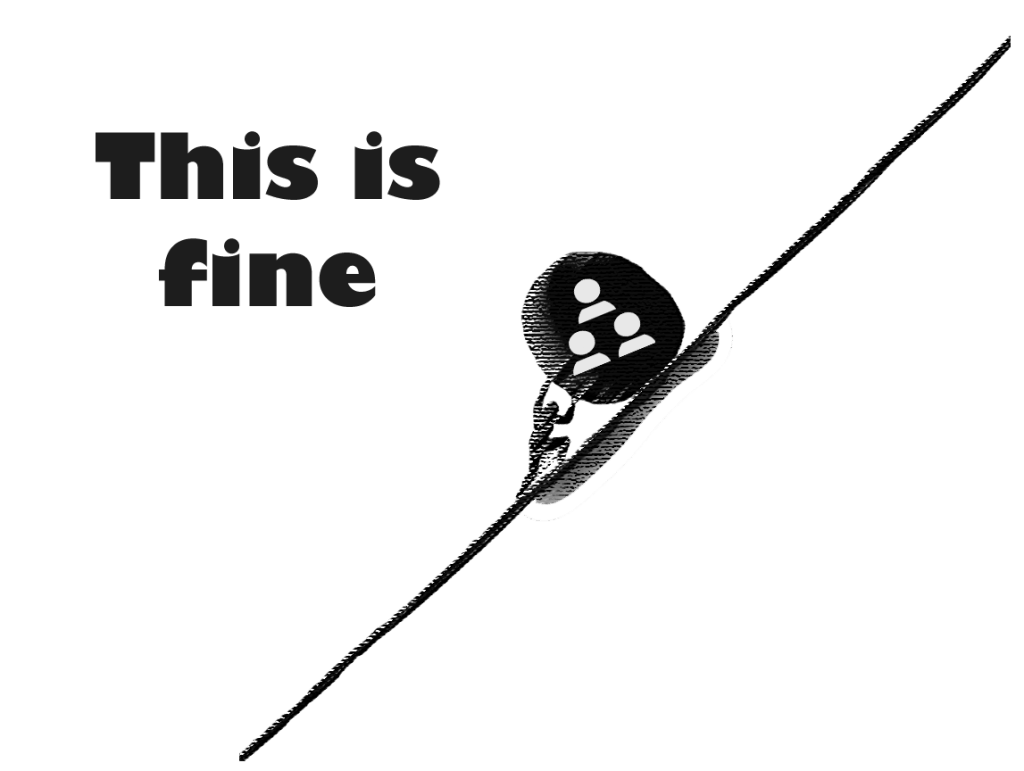
Ed Tech Sisyphus
Sometimes at a slow moving organisations projects take a while.
How do you distinguish slow, painful progress from … well … fooling yourself that something is happening when its not?
One of the main reasons I’m still here is it takes so long to build a reputation and get to know how an organization works. I feel beholden to finish a lot of the work I’ve started here before I even think of my own desires and needs. Yet I realized in the above conversation that ‘finishing’ had become a forelorn dream. I am trapped into being a prisoner of my own desire for relevance and value. My own desire for all the bad elements of the job to amount to something. If I am not part of a larger process then why am I not looking at my career?
Now this is a genuinely peculiar situation I find myself in. I don’t have any intrinsic motivation to be a manager. I don’t have any intrinsic motivation to be a leader. I am in a leadership position due to length of tenure and gosh darn refusal to leave. I don’t have any ambition to go higher in the organization. I truly just wanted to be able to do the job I started in the organization but more professionally. Trying to do that has forced me to act up the ranks and in doing this acting you start to lead, then one day you are just a leader. De facto.
Some of you might recognize this behavior; whether it’s being a white knight or whether it’s just being a good employee I don’t know. How I have dealt with this position of influence is to be as authentic a leader as possible. Being inclusive. Being connected. Being values led. Being honest, even when if it is politically to my detriment.
I try to be an authentic leader in my post. I lead guided by my values, I try to build relationships and nurture those in my team and protect them from the wider stresses of working in HE. I invest a lot of time keeping different stakeholders onside. Not for any material gain but because we are on the same team. It’s nice to be nice. I take a lot on the chin to ensure others don’t have to and I like to think I act with my heart and to a certain extent with love. Yet part of being this kind of leader is having a purpose. In learning technology there is always a purpose you are always on some kind of journey to get to that purpose. So here is the theme of this post…
Can you authentically lead a team when you don’t ‘trust the process’?
Anyone who has followed American sports or even coached a sports team in the last decade will probably be familiar with the phrase ‘trust the process’. Trust the process refers to the idea that what you are doing might feel bad now and you might not see the point or the gains but as long as you engage with what you’re doing to the best of your abilities the endpoint will be worth it. This phrase is particularly associated with the Philadelphia 76er basketball team.
Now as a learning technologist we share similar experiences in our careers. Quite common will be the experience of fixed term roles or roles where you’re on a small specified project or initiative. More common recently is larger central roles that are quite wide in scope. Roles that are nominally powerful but can be beholden and sometime at odds with the Faculties or Schools you serve. Some of us may have or have had local roles, supporting smaller constituencies of practitioners. Where you are at risk of feeling disempowered to affect wider change but connected to your colleagues. A few of you may have roles like mine where you are Faculty based but get dragged into institution wide transformation. Or at the very least are exposed to the consequences of incomplete or failed digital transformation. From this disparate place there are still commonalities we share.
We have got into the habit of talking a lot about certain things that stem from these common experiences. Topics like impostor syndrome, topics like precariousness of employment and the tyranny of fixed term roles. Discussions about hub and spoke models. We talk about the definition of our roles constantly, insecure in our own place as a new cadre of professional. How we fit into incredibly change resistant and sometime hostile environments. We are comfortable talking about influencing up, about dealing with higher paid individuals and some of us are quite brave about talking about the strains of the job online. These are incredibly important. Yet there is another set of problems that we hint at quite often and that’s what I want to talk about in this post.
What happens if the process and the purpose become the same thing? When there is no end and no prospect of an end to bad situations? When there is no prospect to make things better and you have no faith left in the ability of others to deliver and how does this affect middle managers specifically.
Now if I’m honest I’ve got a pretty sweet deal I have a good budget, I have a well-resourced and capable team. We are well liked, connected to our Faculty and well respected in the wider organization. This is largely because we have delivered time and time again despite the context. Now this might sound like the person speaking from a position of privilege. I acknowledge lots of people in the sector would kill to be in that position to have security of tenure and a supportive environment.
Think me a tad ungrateful? I can see your point.
So I am ungrateful
It doesn’t mean that isn’t this isn’t worth dwelling on for a second, there may quite a few of you out there who will now be in the same position.
As a learning technologist sometimes you are asked to sit in a room and deal with issues that aren’t difficult. Dealing with issues that aren’t high faluting or complicated. In fact, a lot of learning and teaching things could be solved with quite simple and consistent application of resource or attention. We know the answers.
Better assessment feedback? It’s really simple when you think about it.
Good project implementation? Also simple when you think about it.
Walking the walk is harder but nothing is theoretically hard. None of the problems I’m experiencing at work are complicated or unknowable. In fact, I think everyone would be able to rattle off the issues and solutions within their organization relatively simply. Providing solutions, however, seem to evade us. We are asked to paper over the cracks and hope that in the background things will be being sorted.
As a manager of learning technologists you are the face of the organisation to your staff and constituency of academics. You are the sense maker, the confidence giver and the purpose provider. You have a lot of pressure to play happy families and act as if there was a higher plan at work. Generally this is wishful thinking and/or spin. Things happen because they happen, there is often little direction and meaning to them.
More often than not you have no idea what it is you are trying to achieve.
I honestly feel like my team is the best team of its type in the organization (I would think that though wouldn’t I?). I have an affinity with them. As you may have guessed from the paragraphs above, I am not without confidence. I believe I’m probably one of the higher ability learning technologists at my organization. I feel I have a good soft skill set with the means to make big impact.
Despite my own confidence and efforts my organisation is unable to consistently move forward with digital education no matter how hard it tries. So how do you deal with a lack of progress at an institution? How do you play happy families without undermining your authenticity and values?
Well you might justify to yourself ‘if I just work harder and do x it will get better’ or ‘if I do this project well enough, that will be done and we can move on’. For managers you are not an island, you also have to share that meaning to everyone and help them keep moving forward. You have to deal with push back on things you are struggling with yourself. You need to be Elsa from the first half of Frozen and look what happened to her. It’s hard. It is harder when there’s another question sometimes that comes to mind when you reflect on it:
Am I making it worse?
I am strongly against crisis managerialism. The idea that to solve a problem is to make it come to its worst point (or at least realize the risks) and provide the solution. It is antithetical to how my brain works. The upshot of this and probably the reason I’m given trust in resource is we get things done. We keep the show on the road. This is a very attractive quality however you have to trust the process. That by doing this it eventually leads to a better tomorrow.
There is another side to this, “am making it worse or not?” might be an academic or self involved question. Maybe my existence at the organization is neutral . The real question could be if I’m here taking up this role is that not robbing someone else of the opportunity to do it? Am I squatting? Is my tenure illegitimate? i.e:
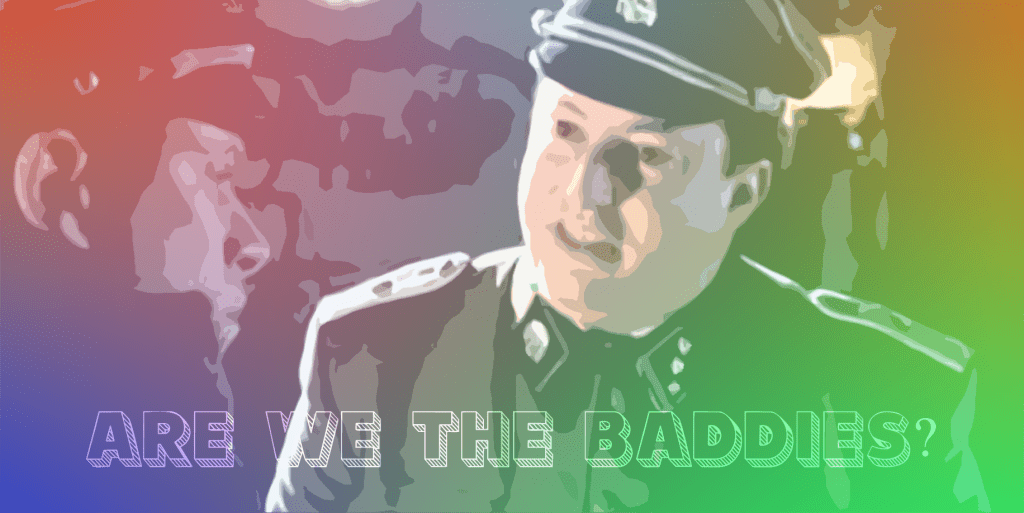
Am I ‘the baddies’?
Hans, are we the baddies?
How does one get to this place? Well in a word, experience.
It is the hope that kills you.
We often talk about hype cycles. A hype cycle for those that don’t know is a chart where expectation is plotted against time. It outlines the life cycle of a new approach and how the sector relates to it over the course of this life cycle. You start with the trigger, you reach a peak of inflated expectations and then are returned to a trough of disillusionment when you go into a slope of enlightenment and the plateau of productivity. Now some might recognize that if we take the technology element out we can have a hype cycle of different institutional changes. Institutions go in cycles as well so if you’re invested institution and you stayed for a while you’ll see this cycle with projects, products or people.
I look back at the mental processes I have gone through in the last five years and it is a host of ‘it will be better if this / when this product is implemented properly’ or ‘when this website is finished’ or ‘when this unit is set up’ or ‘when that replacement unit is set up’ or ‘when this new VC starts / when their project manager they’ve decided to hire starts / when the new director roles starts’ and on and on. Jam always tomorrow.
If you invest hope in too many of these cycles then this burns you out. If I am honest, I have been shouldering too much, taking responsibility for things I can’t affect but also believing it will all be worth it. Whilst also being absolutely sure none of it will change. There is always one final change and we will have good foundations but knowing we aren’t going to see that change. Why didn’t I apply for that job? I am miserably stuck in my head and painfully aware of it.
What do I mean by stuck? The experience of being a manager can easily be exposing and lonely. It relies on you have a good team and set of managers heading towards shared priorities. Without that plan or trust in your manager squad you have to rely on individual resilience to not let set backs drag you down. That tank of resilience is not infinite. Being ‘stuck’ means being motivated to protect my team, feel connected to my team and build my team but demotivated by a sense that it is pointless to. We will always be let down. A sense that protected or not on the macro level, nothing productive will happen. The team is in itself is its only chance.
For all managers there are always times when you forget why you are frantically keeping the plates spinning. Times you look around you and you see no one has followed you into battle. You have gone out on a limb for something people no longer feel invested in. However, this is not that time. I am not afraid to say I am suffering from a tyranny of low expectations, a learned pointlessness if you will. Cruelly saddled with also caring greatly about that situation. Despite it being uncontrollable by me. You arrive at a state where…
Every failure feels like abuse, every new initiative that you don’t agree with feels like a sleight, every retread of a past failure feels like a sick joke.
I do feel a real sense of guilt everyday that I don’t try my hardest. This is mixed with a real sense of frustration that no matter how hard I try it doesn’t seem to ever make THE difference. This is indulgent and I know a lot of you are thinking, ‘why don’t you just leave again let me have a chance, let me have a shot’ but I think it’s something we do not deal well with as a sector. I think it’s something that is corrosive to our mental health.
You get stuck. You are in a constant tension with yourself as a human and as a manager.
This is not an indirect or direct attack on my colleagues, as I said before I have genuine relationships with people at work. I would like them to think of me primarily as a person and an irritant in meetings second. Yet most more senior learning technologists would have experience that moment when your brain says
‘Yeah, yeah I believed that would happen the first four times someone told me but now I am not buying it’.
if you believe that I have a bridge to sell you
This is bad enough but highly problematic if you are an authentic manager. The gap between your life and work is smaller. It infects your life. It outstrips your coping mechanisms. You are in touch with a wide network of people. You invest A LOT of emotional labour into your work networks and pride yourself on being honest. If you don’t trust the process for too long how can you be honest or connect with people?
Now I know I’m being possibly a bit millennial about this, possibly overanalyzing this by losing myself in thoughts like.
WHAT IF I am robbing other people of opportunities by not freeing up my role for someone with a better attitude?
WHAT IF by not causing a massive failure by leaving we will never have a reorganization with new opportunities being borne out of it?
WHAT IF I am just wasting my career here.
WHAT IF you’re still incredibly emotionally attached to the work and the place in which you are employed.
It may sound jaded and dangerous but might they all be a pertinent questions? I know it isn’t a healthy place to be mentally but when you have invested a lot of emotion in a role its hard to be rational.
When you feel like you are going nowhere how do conceive of being somewhere else?
What people who don’t realise about being a Learning Technologist is that we are an emotional bunch. We genuinely want to improve things. At times we get incredibly emotionally attached to the weirdest things, they represent the opportunity for progress and a social good. Therefore self worth. Lack of progress can equate to feeling like your role has no value and in HE there are enough actors trying to devalue you without you devaluing yourself. If you lead authentically you can carry this pressure for those you manage. If you are feeling the same it is a lot to carry.
How long can you think like that and be authentic without it harming your mental health or leading to unprofessional behaviours. What happens when that attitude is the logical response to most work based eventualities? What is a leader meant to do then?
It is almost like a break up. I don’t know the answer but I’m guessing a lot of you out there feel the same.
Why is this a problem? Well aside from unhappiness itself being an issue we have something of a crisis in this country. The crisis is leadership and vision. Stepping outside of the given reality and setting a new course rather than reacting to events. I know what good learning technologist savvy leadership feels like and it is really empowering. It makes such a difference. If we lose too many people from the management strata we compound this issue. We shrink the pipeline for good decision making in the future. Who would want to be a middle manager put in a hopeless position? I know I have had people tell me how unattractive it all looks. Research is great. Teaching is great. eLearning development is great. However, without clued up and resilient management everything is harder than it needs to be. This means we need to take issues such as this seriously. Give people tools, support and incentives to rise above this. Otherwise we will be creating a self fulfilling prophecy of pointlessness.
Sad comedy trumpets sound
Call it disempowerment, call it the downside of being an authentic leader but we probably need to talk more about middle manager things. Knowing the difference between an organisation being slow and an organisation being lost. How to rescue good managers who have been warped by not trusting the process and how we retain human capital healthy in such an erratic part of the sector. We might need to create new routes for support across the sector as it is hard to talk about these things internally. This can be for fear about progression or for not wanting to seem disruptive. As a manager you are seldom allowed to have flaws.
This is where the blog post ends. There is no puffing out the chest and a call to arms. Merely unanswerable questions and a new found fear of someone reading this and taking it the wrong way. Yet it is important to care, it is important to be honest and it is important acknowledge the dangers of authentic leadership in slow moving organisations. You may one day be managing someone as mentally stuck as me and you might need to recognise it. No idea how you fix it mind.
This is an .SVG for healthcare professionals or e-Learning professionals in the UK. It was drawn by me. It is quite along ANIMATION as there is loads of details on the image.
This is an .SVG for e-Learning professionals or digital content creators in the UK. It was drawn by me. It has been used on VideoScribe but never in a published artifact:






















 The Educologist